SOC 2 Type II reports: an IP buyer’s evidence guide
May 16, 2024
An unpublished invention disclosure can contain technical details, commercial plans, and counsel’s working analysis. Before those materials enter an intellectual property (IP) platform, your patent team needs a defensible vendor-qualification decision. A security badge provides little detail about the service, controls, or period examined. Your review needs to connect a System and Organization Controls (SOC) 2 Type II report, any required information security certificate, and scoped vendor answers to the patent workflow you intend to approve.
What SOC 2 Type II tells an IP buyer
For an IP platform, request the SOC 2 Type II report for the service your team plans to use. SOC 2 is an examination and reporting framework developed by the American Institute of Certified Public Accountants (AICPA). An independent certified public accountant (CPA) examines a service organization’s system description and controls against applicable Trust Services Criteria.
The categories are security, availability, processing integrity, confidentiality, and privacy. Record which categories the particular examination covers. A report’s scope determines the controls and service commitments addressed. The AICPA reporting guide explains this system-level examination.
The report type changes the evidence available:
- Type I: Addresses the system description and suitability of control design as of a specified date.
- Type II: Also addresses operating effectiveness during a specified period and includes the auditor’s control tests and results.
This distinction appears in the AICPA’s guide excerpt. For a patent team preparing to share confidential materials, Type II adds evidence about how the described controls operated during the examination period.

Use precise credential language: SOC 2 Type II attestation or SOC 2 Type II report. Patlytics has completed a SOC 2 Type II examination. Its Trust Center provides a report-access request route, alongside ISO certificate resources. Carry the report’s actual scope and dates into your qualification record.
SOC 2 Type II and ISO 27001 answer different questions
ISO/IEC 27001, published jointly by the International Organization for Standardization (ISO) and the International Electrotechnical Commission (IEC), sets requirements for an information security management system (ISMS). It addresses an organization’s approach to managing information security risks. The IEC standard description identifies ISO/IEC 27001:2022 as a requirements standard for establishing, maintaining, and improving that management system.
An ISO 27001 certification and a SOC 2 Type II report can both support vendor qualification. Treat them as separate evidence, with separate boundaries.
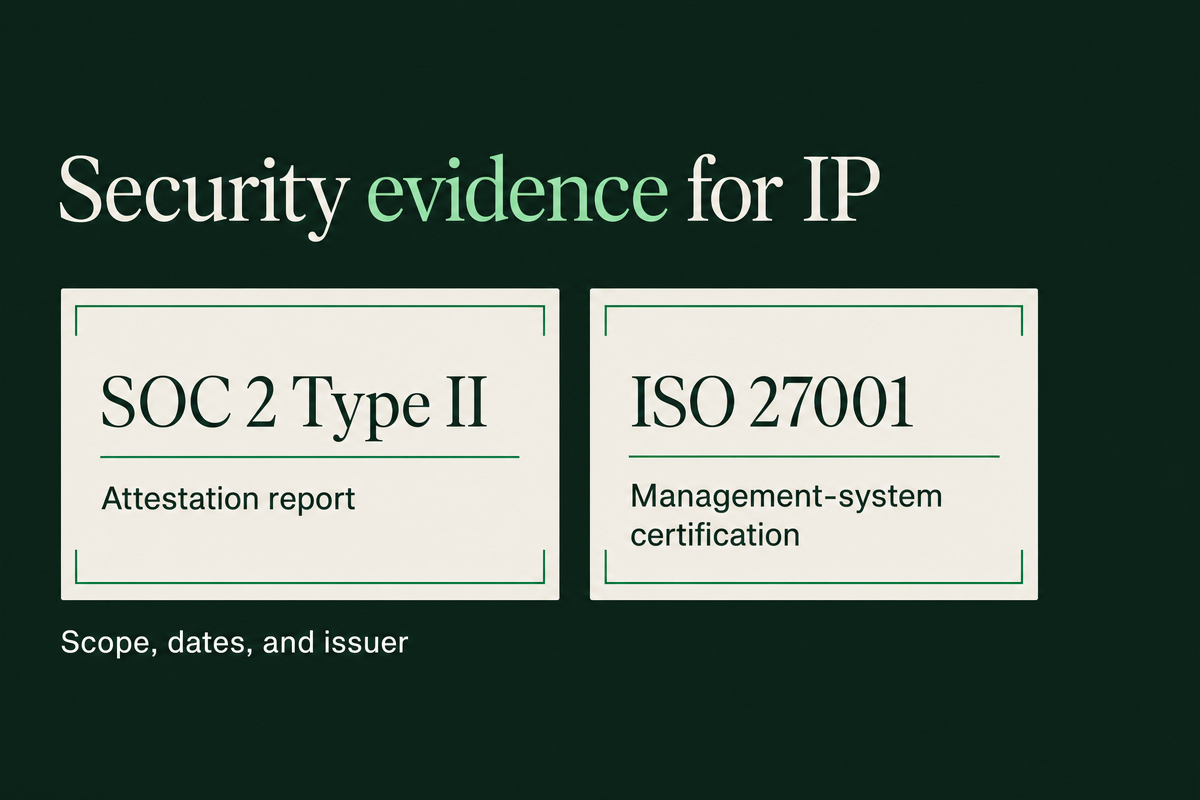
| Comparison point | SOC 2 Type II report | ISO 27001 certification |
|---|---|---|
| Evidence category | Independent attestation report | Management-system certification |
| Subject | Described service system and controls against applicable Trust Services Criteria | ISMS within the certified scope |
| Issuer | Independent CPA service auditor | Certification body |
| Time information | Examination period and report date | Certificate dates and current certification status |
| Detail for the buyer | Opinion, management assertion, system description, control tests, and results | Certified entity, locations, scope, standard version, issuer, and identifier |
| IP procurement use | Map examined controls to the intended service and data flow | Map certified activities and locations to the intended service |
A certification body audits the management system and issues its certificate. The ANSI National Accreditation Board’s (ANAB) certification guidance describes that process. Request the vendor’s certificate, then record the entity, covered activities, locations, and standard version shown on it. The version of the standard described above is distinct from the version stated on any particular vendor’s certificate.
A SOC 2 report and an ISO 27001 certificate are distinct evidence. Your organization’s procurement requirement determines whether it accepts one, both, or an alternative. Record how each accepted document satisfies that requirement for the proposed deployment.
Read the SOC 2 report against your patent workflow
Start with a short statement of intended use. “Patent drafting” is too broad to define the data boundary. A useful statement names the inputs, processing, work product, and people who will handle it. For example: inventor documents enter a disclosure workflow, approved disclosures become application drafts, and patent counsel reviews the output before further use.
Request the complete report through the vendor’s authorized access process. Keep it within the permitted review audience and document-handling conditions. Assign the security reviewer to the controls analysis and patent counsel to the intended use and matter requirements.
The AICPA identifies the opinion, management assertion, system description, controls, tests, and results as key report elements. Read them together using the following sequence.
1. Match the entity, service, and system boundary
Record the legal entity and named service. Read the system description for the components, activities, and boundaries included in the examination.
Map your planned data path to that description: upload, processing, storage, support access, and export. Where artificial intelligence (AI) processing forms part of the workflow, identify how that processing fits within the described system and its dependencies. A report for a related service needs a documented connection to the service your team will buy.
Record unresolved scope questions explicitly. Give each one an owner and a required answer before approving the affected data use.
2. Record the examination period and subsequent changes
Copy the period’s start and end dates and the report date into the review record. Compare the examined service with the proposed deployment. Ask for an account of material changes since the period ended, particularly changes affecting the data path you mapped.
Keep any management bridge letter separate from the auditor’s report. Record its author, date, covered interval, and statements about subsequent changes. Attribute those statements to management and retain the auditor’s examination period unchanged.
Set a follow-up date under your organization’s vendor-risk policy. Use the report’s actual dates and the deployment’s changes, rather than treating a SOC 2 badge as a permanent approval.
3. Read the opinion, assertion, and test results together
Record the auditor’s opinion and any modification. Read management’s assertion to understand what management represents about the system and controls. Then inspect the tests and results relevant to your data path.
For each relevant exception, record the affected control, test result, management response, and supporting remediation evidence available. Have the security reviewer assess the effect on the intended deployment. Preserve the distinction between an observed test exception, management’s explanation, and the auditor’s overall opinion.
For confidential invention materials, access-control and change-management findings deserve attention because they relate to who can reach the materials and how the service changes. Select the relevant findings from the actual report rather than assuming every report uses the same controls or test procedures.
4. Assign customer responsibilities
Complementary user entity controls are controls the report expects the customer organization to implement. Translate those expectations into named responsibilities for your deployment, such as account administration or access removal, where the report calls for them.
Record the responsible team and the implementation evidence. If outside counsel will participate, define who administers access and who removes it when a matter or engagement ends. Keep this assignment tied to the report’s actual requirements.
5. Identify how subservice organizations are treated
A subservice organization performs part of the service, such as hosting. Under the inclusive method, its relevant controls are included in the examination. Under the carve-out method, those controls are excluded from the examination.
Record the method and dependencies relevant to your intended use. For a carved-out dependency, have the security reviewer identify the additional assurance evidence needed. The AICPA’s report walkthrough covers customer controls, subservice treatment, opinions, exceptions, and bridge letters as report-review topics.
Inspect the ISO certificate separately
Request the actual ISO 27001 certificate and retain the supporting status information in the same qualification file. Record:
- The certification body’s name and contact details.
- The certified organization’s name and geographic locations.
- The scope of certified activities or services.
- The standard and version.
- The issue date and any expiration date shown.
- The certificate’s unique identifier.
Use the issuing certification body’s validation route to establish current status. ANAB’s certificate review guidance identifies these fields and directs validity questions to the issuer.
Compare the certified scope with the SOC 2 system description and your proposed service. Document any difference in entity, location, or activity. Procurement can then distinguish a credential that applies to the intended service from one covering a different part of the vendor’s operations.
Build a workflow-specific qualification record
Combine the evidence in a decision record that identifies the permitted use, document references, open questions, owners, and approval conditions. Keep report contents within their access restrictions; summarize the procurement decision without circulating restricted findings beyond the authorized audience.
The following fictional example concerns an in-house patent team evaluating a disclosure-to-draft workflow. It illustrates a review record, with no findings about any actual provider.
| Review field | Fictional record |
|---|---|
| Intended use | Research and development documents become invention disclosures and application drafts for counsel’s review. |
| Proposed data | Unpublished technical descriptions, figures, and inventor responses. |
| SOC 2 evidence | Record the authorized report reference, entity, system, period, opinion, and relevant tests. |
| ISO evidence | Record the certificate reference, issuer, entity, scope, standard version, dates, and status confirmation. |
| Open scope question | Confirm how the proposed AI-processing path maps to the examined system and listed dependencies. |
| Customer responsibilities | Security reviewer extracts required customer controls; account administrator records their implementation. |
| Decision condition | Patent counsel and security reviewer approve this workflow’s data use after the scope question and assigned controls are resolved. |
| Follow-up | Reassess at the organization’s vendor-review date or when the approved data path changes. |
Attach service-specific written answers where the documents leave an important question open. For invention data, those answers may concern customer-data model training, retention of uploaded materials and generated drafts, or processing locations. Keep each answer tied to the data class and service involved. A statement about account history should remain separate from the retention terms for invention files or backups.
Preserve a separate attorney-review step for patent work. Counsel reviews technical support, claims, citations, and legal analysis before relying on a draft or report. Vendor-control evidence belongs in the security decision; substantive patent review belongs in the matter workflow.
For the enterprise business case, budget the security, procurement, and counsel time needed to complete this record. Align the first approved workflow with the patent team’s roadmap, such as disclosure intake followed by application drafting. Schedule the evidence review alongside the patent-workflow evaluation so scope questions reach their owners early. Reuse the qualification record for later deployments, with updates for their service and data boundaries. Record additional review cost and outstanding questions before expanding to new data classes or workflows.
Where Patlytics fits
Patlytics is built for patent practitioners working across connected patent workflows. The Invention Disclosures (IDF) module turns inventor materials into structured invention disclosure forms for review. Patent Drafting supports the next step from disclosure materials to application drafts. Attorneys retain review and decision authority over the work product before submission or further use.
Patlytics’ security credentials include SOC 2 Type II attestation, ISO 27001 certification, and ISO 42001 certification. Patlytics does not use customer data to tune or train its models without explicit consent or necessity. The security overview describes these safeguards, and the Trust Center lets your team request the SOC 2 Type II report directly. Record the applicable document scope, dates, and customer responsibilities for the deployment you intend to approve.
See how Patlytics moves confidential invention materials from disclosure to an application draft for attorney review. The platform has SOC 2 Type II attestation, alongside ISO 27001 and ISO 42001 certifications. Book a demo tailored to your disclosure-to-draft workflow.
The Premier AI-Powered
Patent Platform
Reduce cycle times. Increase margins. Deliver winning IP outcomes.